






Built for the Games.
Made for Decades.
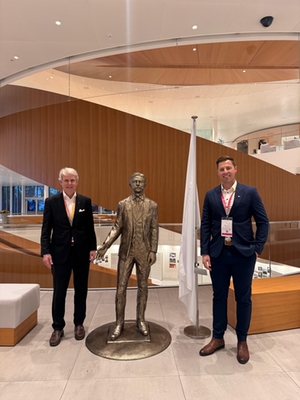
For the first time, the IOC Legacy Department invited International Federations to the Olympic Legacy Forum of the World Union of Olympic Cities, and luge was at the table. In Lausanne, FIL Secretary General Dwight Bell and Sports Director Matthias Böhmer presented luge as a case study for the Olympic Winter Games.
Only two winter federations were present at the Olympic Legacy Forum: FIS and the FIL. On 16 November, Bell and Böhmer used the stage in the Olympic Capital to show how sliding tracks can live on long after the closing ceremony, and how the FIL works with host cities to make that happen.
“The most important thing an Olympic legacy city can do is continue to host international events on its venues,” said Dwight Bell. “The International Luge Federation is unique, as we go back to our Olympic venues more than any other sport, and not just with World Cup races, but with junior races, international training and development camps. We appreciate the invitation by the IOC Legacy Department and the opportunity to have participated in this important event, to spend time with all our legacy partners and to forge even stronger relationships with them.”
Four years, eight years, fifteen years
The FIL builds on three levels: a four-year calendar, an eight-year strategy and a fifteen-year vision. The first four-year calendar in the federation’s history fixes every World Cup stop up to the 2030 Olympic Winter Games. Every season, the World Cup and World Championship race on five former Olympic tracks. This winter, they are PyeongChang (2018), Yanqing (2022), Innsbruck (1964 and 1976), Cortina (2026) and La Plagne (1992). In the following winters, Whistler (2010), Park City (2002 and, next, 2034), Lake Placid (1932 and 1980) and Lillehammer (1994) will join the list.
The calendar is only the beginning. The FIL supports ongoing operations and helps operators build a financially sustainable business model around the field of play. It ensures that sporting events take place regularly, and it trains local technical officials and volunteers. Every track that stays active keeps a community of athletes, coaches and fans alive.
PyeongChang shows the way
The strongest example comes from Korea. Together with the PyeongChang 2018 Legacy Foundation and with support from Olympic Solidarity, the FIL has turned the 2018 Olympic track into a hub for the whole of Asia. Every year, a luge school for Asian countries takes place there. The partners provide the track, accommodation, coaching and equipment, and the participants combine sport with education. The latest FIL Luge School PyeongChang took place in March 2026. On the same track, the luge medals of the Gangwon 2024 Youth Olympic Games were awarded. Eight years after the Games, PyeongChang is a place where new luge nations take their first runs.
From 1964 to 2030
This winter, the World Cup returns to PyeongChang and Yanqing. In February, the World Championships in Innsbruck-Tirol follow, carrying on the legacy of the 1964 and 1976 Games. Cortina, the venue of 2026, is on the calendar in three of the four seasons up to 2030. And La Plagne, which hosted luge at the 1992 Games, will stage the Olympic competitions again in 2030. Olympic history and the future of the sport meet on the same ice.


