





Forty-Two Years on Ice: The Claire DelNegro Story
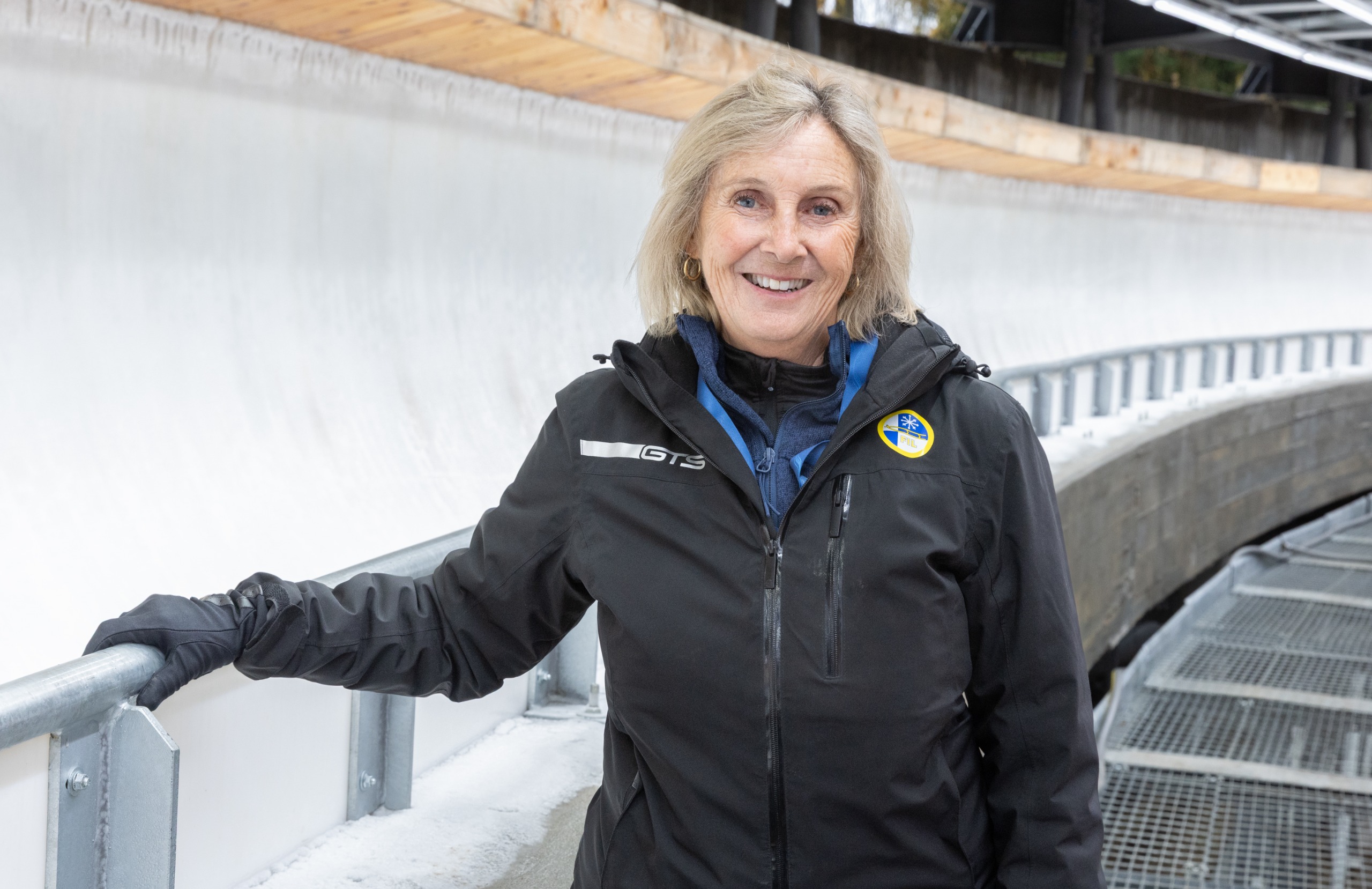
There is perhaps no one in the history of international luge who has seen this sport from as many angles as Claire DelNegro. Athlete. Coach. Team manager. Olympic organiser. Federation vice president. Inventor of the Hall of Fame. Pioneer of the finish area spectator tribune. Forty-two years in a sport she never planned to stay in quite so long – and would not change a day of.
The athlete
It began on the track. From 1979 to 1985, DelNegro competed nationally and internationally, and in 1984 she stood at the start line in Sarajevo, Yugoslavia, representing Great Britain at the Olympic Winter Games. "Competing at the Olympics was the highlight as an athlete, as it is for every athlete," she says. The Olympics, she adds simply, are something else entirely.
Building a team from scratch
After her competitive career ended, DelNegro threw herself into management – and found a new kind of satisfaction. Working for USA Luge as coach, team manager and programme director, she built something from the ground up. "I really enjoyed working hard and had great pleasure working for the US team as team manager from scratch, bringing athletes to Olympic medals." In 1998, her athletes won the first Olympic medals in the history of American luge.
Salt Lake City, 2002
The 2002 Winter Games brought two memories she carries to this day. As Director of Sliding Sports for the Olympic Organising Committee, she fought a battle that seemed straightforward to her but proved anything but: she pushed for spectator tribunes at the finish area. Everyone told her no one would want to stand there, that fans preferred the track. She pushed anyway. Today, finish area spectator stands are common sense at every major luge event. She smiles at that one. And then, one day, she and six or seven other retired athletes were quietly surprised by the co-organisers: each of them had been given a slot to carry the Olympic Torch on the day of the Opening Ceremonies. Claire DelNegro was a torchbearer at the 2002 Winter Games. A moment, she says, she never saw coming and will never forget.
Twenty-eight years at the FIL
"When colleagues suggested I join the FIL Board, they said I would have two or three meetings per year," DelNegro recalls. She committed in 1998. She never thought she would stay for twenty-eight years.
Those decades were filled with moments that tested the sport and the federation alike. The most painful came at the 2010 Vancouver Olympics, when Georgian luger Nodar Kumaritashvili lost his life in a training crash on the morning of the opening ceremony. DelNegro speaks of the exhaustive internal and external analyses that followed – unflinching and honest. "At the end, it came out that it was a tragic coincidence of a lot of mainly technical errors." The response was immediate and structural: the FIL changed its qualification standards, introducing additional races and trainings on the Olympic track itself for less experienced but qualified athletes. "It is a good example of how, in all these decades, the FIL always has reacted and moved forward."
And forward it has moved, in every direction. A permanent office building purchased in Berchtesgaden. A professional Sport Director and Technical Director structure introduced to guarantee consistent standards at every World Cup. New competition formats – the successful introduction of both the Team Relay and the Women's Doubles into Olympic competition, and the application for the new mixed singles and mixed doubles to be added to the programme, with hopes they will one day become Olympic races. The Hall of Fame, which DelNegro herself invented, giving the sport a place to honour its greatest names.
In Sochi in 2014, another highlight attended her, "not as an athlete, but as a FIL Vice President." She had the honour of presenting the medals at the men's doubles event. "It was a very special moment," she says. She had the honour of repeating that presentation with the Women's Single in Milano-Cortina. Both stand out as special moments to share in the excitement of the athletes.
On the sport itself
"Luge is an easy sport to understand," DelNegro says with a smile. "Only the time matters. There are no judges. It's really simple." And yet, she adds, luge is also complex and sophisticated, with all its physical and technological aspects. "It's hard to convey how important and how difficult it is to choose the right line, and then to use the G-force to accelerate in the curves. The athlete, the coach, the technical sled – everything comes down to the capacity of the athlete."
Her advice to anyone who wants to understand luge is straightforward: come to the track. Watch it live. "It's important to see luge on the track because the most important part is the speed and the sense of speed. It's better to experience it live than in front of the television." Perhaps, she adds, the availability of drone footage will continue to improve to capture it better.
What she loves most about it is the camaraderie. "Each athlete runs against the track and the clock, but is not in direct contact with other athletes." And yet the community is remarkable for its generosity: "Nations are helping each other share knowledge, share how to improve, and this is great for the sport."
Claire DelNegro served as FIL Vice President Sport Artificial Track from 1998 to 2026. At the 74th FIL Congress in Berchtesgaden, she was awarded the FIL Diamond Medal of Honor and inducted as an Honorary Member of the International Luge Federation.