





Four Weeks to Go Until the Anniversary Luge World Cup Season
Fifty winters. Fifty seasons. Fifty times the first push off the start, the first scratch of steel on fresh ice, the first rush through a curve that only makes sense when you’re lying down.
On November 27, 2026, the EBERSPÄCHER Luge World Cup gets underway in Winterberg for the 50th time — and it does so in its own way: not with nostalgia, but flat out.
Ten Stops. Five Olympic Tracks. One World Champion.
The anniversary season calendar reads like a map of global luge: from Winterberg to PyeongChang and Yanqing — two stops that underline the growing importance of the Asian market as an indispensable part of the FIL World Cup — then back to Europe for Sigulda, Altenberg and Oberhof, before the 54th FIL World Championships in Innsbruck Tirol from February 1–7, 2027 mark the season’s pinnacle. From there the circuit continues to Cortina, La Plagne and the finale at Königssee.
What makes this calendar unique: five of the ten competition venues have hosted the Olympic Winter Games — PyeongChang 2018, Yanqing 2022, Cortina 2026, La Plagne 1992 and Innsbruck-Igls, which wrote Olympic history in 1964 and 1976. That is no coincidence — it is policy. The FIL has long been committed to legacy and sustainability, building its World Cup on tracks where the investment has already been made, where venues endure. Five Olympic ice tracks in a single winter: that is the self-understanding of a sport that takes responsibility seriously.
The Olympic Champions From Cortina Arrive Hungry
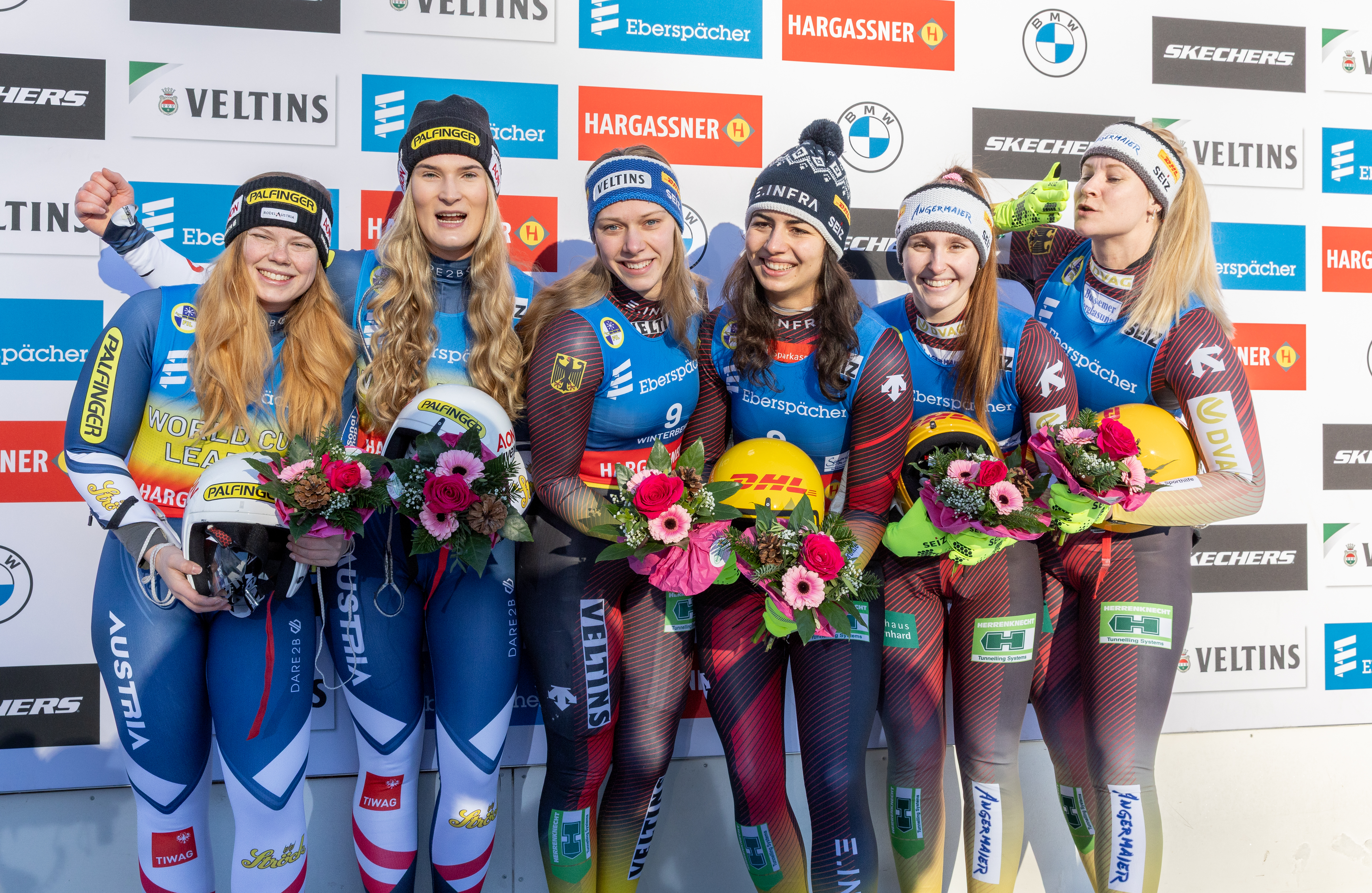
Julia Taubitz took gold in Cortina 2026 — and in luge, that doesn’t mean you sit back. It means the pressure from behind gets heavier. Max Langenhan, who triumphed in the men’s singles, enters the anniversary season as defending Olympic champion — with everything that implies in terms of expectation, motivation and target on his back. Marion Oberhofer and Andrea Vötter, Olympic champions in the women’s doubles, are determined to prove that Cortina was no fluke. The same goes for Emanuel Rieder and Simon Kainzwaldner, who also returned from the Olympic Winter Games with gold.
Behind them: a generation that isn’t waiting.
New Sleds. Equal Footing. No Excuses.
The anniversary season brings a technical watershed: the new FIL standardized sled. Everyone races it. Anyone who pulls away from the field this winter does so not because of superior materials engineering — but because of superior technique, superior nerves and superior courage. The standardized sled is the most honest thing to happen to luge in years.
Strong Partners for a Strong Anniversary
The fact that the Luge World Cup is celebrating its 50th birthday at this level is also a reflection of its partners: EBERSPÄCHER as title sponsor of the World Cup, alongside Hargassner, Skechers and AXA — backing a season with more global visibility than ever before.
50 Years — and Not the Least Bit Tired
When the first FIL Luge World Cup was held in 1977/78, no one could have imagined what it would become: a global racing series, a winter highlight on three continents, a sport that pushes its athletes to the absolute limits of what is physically possible — and does so with maximum elegance.
Fifty seasons later, the World Cup is bigger, faster and more international than ever. We celebrate the anniversary the way luge demands: by simply going.
Winterberg. November 27. Four weeks.


