






From Bangkok to the Ice: Thailand's Luge Journey
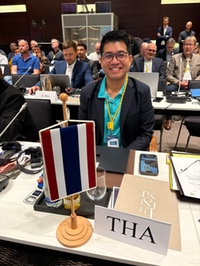
There is no snow in Thailand. There never has been. The country sits squarely in the tropics, its 70 million people accustomed to heat, humidity and monsoon rains – not ice tracks, starting handles and thousandths of a second. And yet, in the summer of 2026, a representative of the Ski and Snowboard Association of Thailand (SSAT) sat in the Hotel Kempinski in Berchtesgaden as a provisional member at the 74th FIL Congress. Luge had arrived in Thailand. And Thailand, it turns out, had been waiting for it.
"There is no snow in Thailand," says Phuwadol Samphaongoen of the Ski and Snowboard Association of Thailand – the national governing body that covers skiing, snowboarding, biathlon, bobsleigh, skeleton and luge – with a matter-of-fact smile that contains no apology and no embarrassment. It is simply a fact, and one that Thailand has learned to work around. "But luge is possible as street luge on wheels. That is our way in."
It is a way in that has already produced results that nobody, perhaps not even the Thais themselves, could have predicted when it all began.
A dream on wheels
The story starts in Bangkok in May 2022, when FIL Development Director Fred Zimny and FIL Head Coach Maciej Kurovski flew to the Thai capital to run a summer training camp with 22 athletes aged 14 to 16. They trained at a brand-new ice-skating hall, at the Rajamangala National Stadium, and on a hill in the seaside resort of Rayong, about 90 minutes from Bangkok, using wheeled sleds. The athletes had been spotted by coaches from the SSAT. They underwent physical tests and were assigned to different winter sports based on their performance and interests. Some went skiing, some to bobsleigh. A handful discovered luge – and found that it suited them rather well.
Among them was Sunita Chaiyapantho, who had started out on roller skis before transitioning to the wheeled sled. "Luge has already given me so many life-changing experiences," she said ahead of the Gangwon 2024 Youth Olympic Games. "Now all I can think about is becoming Thailand's first female luge athlete at the Youth Olympic Games. I'm doing everything I can to prepare for it."
She did it. At the Gangwon 2024 Winter Youth Olympic Games in South Korea, Chaiyapantho and her compatriot Thiraphat Sata made history as Thailand's first luge athletes at an Olympic event of any kind. The journey from that Bangkok training camp to the Olympic Sliding Centre in Pyeongchang had taken less than two years. "Thailand has been a great success story in a relatively short period of time," said Zimny. Chaiyapantho, now in her late teens, could yet be a candidate for further major competitions in the years ahead.
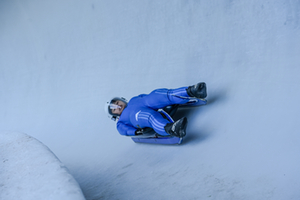
The challenge that remains is structural. "There is no club infrastructure yet," Samphaongoen acknowledges. Building a sport from scratch, in a country where winter is a concept borrowed from elsewhere, means starting with individuals, not organisations. The athletes come first. The clubs will follow.
Why it matters beyond Thailand
The Thai story is not an exception. It is the point.
Luge is, at its summit, one of the most technically demanding and physically extreme sports in the Olympic programme. The world's best athletes train for years to master the thousandths of a second that separate gold from silver. At that level, the sport belongs to a small number of nations with long traditions, sophisticated infrastructure and deep talent pools. Germany, Austria, Italy, Latvia – these are the powerhouses that have defined the sport for decades.
But a sport that aspires to be truly global cannot live at its summit alone. It needs a broad base – athletes who may never stand on an Olympic podium, who may never even race on artificial ice, but who discover through a wheeled sled on a Bangkok hill that speed is addictive, that concentration is its own reward, and that belonging to a global community of athletes is something worth pursuing.
This is precisely the logic behind the FIL's strategy "We Slide Forward 2034," adopted at the Berchtesgaden Congress. Expand and modernise artificial track luge. Develop and scale alpine luge to reach a global audience. Strengthen national federations. Place athletes at the centre. The strategy recognises something that Thailand's story illustrates perfectly: the path to the top runs through the grassroots. Not everyone who picks up a wheeled sled in Bangkok will become an Olympian. Most will ride for fun, for community, for the simple joy of going fast. And that, says FIL President Einars Fogelis, is exactly the point. "A broad base of luge enthusiasts is the foundation from which the elite of tomorrow and the day after tomorrow will emerge."
Street luge, roller luge, alpine luge on ski slopes, natural track luge in the mountains – these are not poor substitutes for the real thing. They are the real thing, adapted for the world as it actually is. A world where most people live far from an artificial ice track but not so far from a hill. A world where the joy of sliding does not require snow, and where a teenager in Bangkok can discover a sport that will take her to South Korea, and perhaps further.
Thailand's luge journey is young. The club structure is still to be built. The infrastructure is still to be imagined. But the athletes exist, the federation is in the room, and the FIL is paying attention. In Berchtesgaden, a seat at the Congress table was a beginning. What comes next will be written on wheels – and one day, perhaps, on ice.