






Olympic Luge Story
How Canada’s Alex Gough conquered Sochi blues to make Pyeongchang history
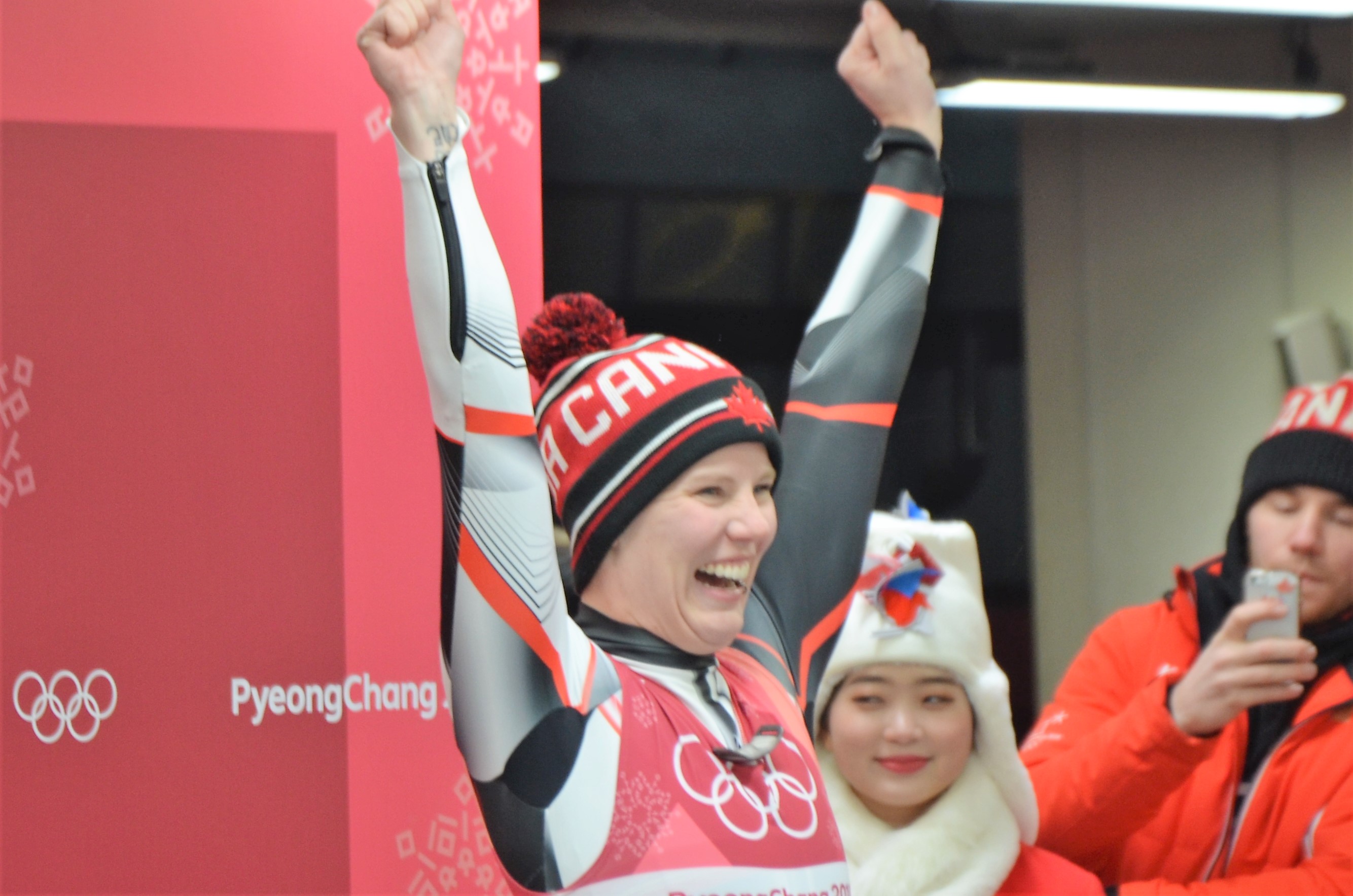
Cortina (FIL/30 Jan 2026) From the moment Alex Gough stepped onto the senior international stage, expectations followed her closely. Within Canadian luge circles, she was seen not just as a talent, but as a promise. Early results justified that belief: a Junior World Cup silver medal, fourth place at the 2005 Junior World Championships, and qualification for the Torino 2006 Olympic Winter Games at just 18 years of age. A fourth-place finish at the 2009 World Championships in Lake Placid confirmed that Gough belonged among the world’s elite.
Then came the breakthrough that truly announced her arrival. In 2011, at Paramonovo, Gough won a women’s singles World Cup race that ended Germany’s astonishing run of 105 consecutive gold medals in the discipline. It was a result that sent shockwaves through the sport. But as history would later show, her legacy would not be defined by a single victory, or even by consistency alone. Like so many luge legends, her story would ultimately be written at the Olympic Games—through disappointment, resilience, and finally, redemption.
The weight of fourth place
By the time the Sochi 2014 Olympic Winter Games arrived, Gough was already an established force. She had climbed World Cup podiums, battled Germany at the front of the field, and finished the 2014/15 season with her best overall World Cup result, taking silver. Yet Sochi would prove cruel.
In the women’s singles race, Gough finished fourth, just 0.433 seconds behind American bronze medallist Erin Hamlin. The same fate followed her in the team relay. So close to a medal—twice—but ultimately empty-handed, the experience left deep marks.
“It was a gut punch,” she would later reflect. “Being that close… it’s hard to process.”
The disappointment was not about form or preparation. It was about fractions, timing, and the unforgiving nature of Olympic competition. And yet, those narrow misses would become the foundation for what followed.
A different road to Pyeongchang
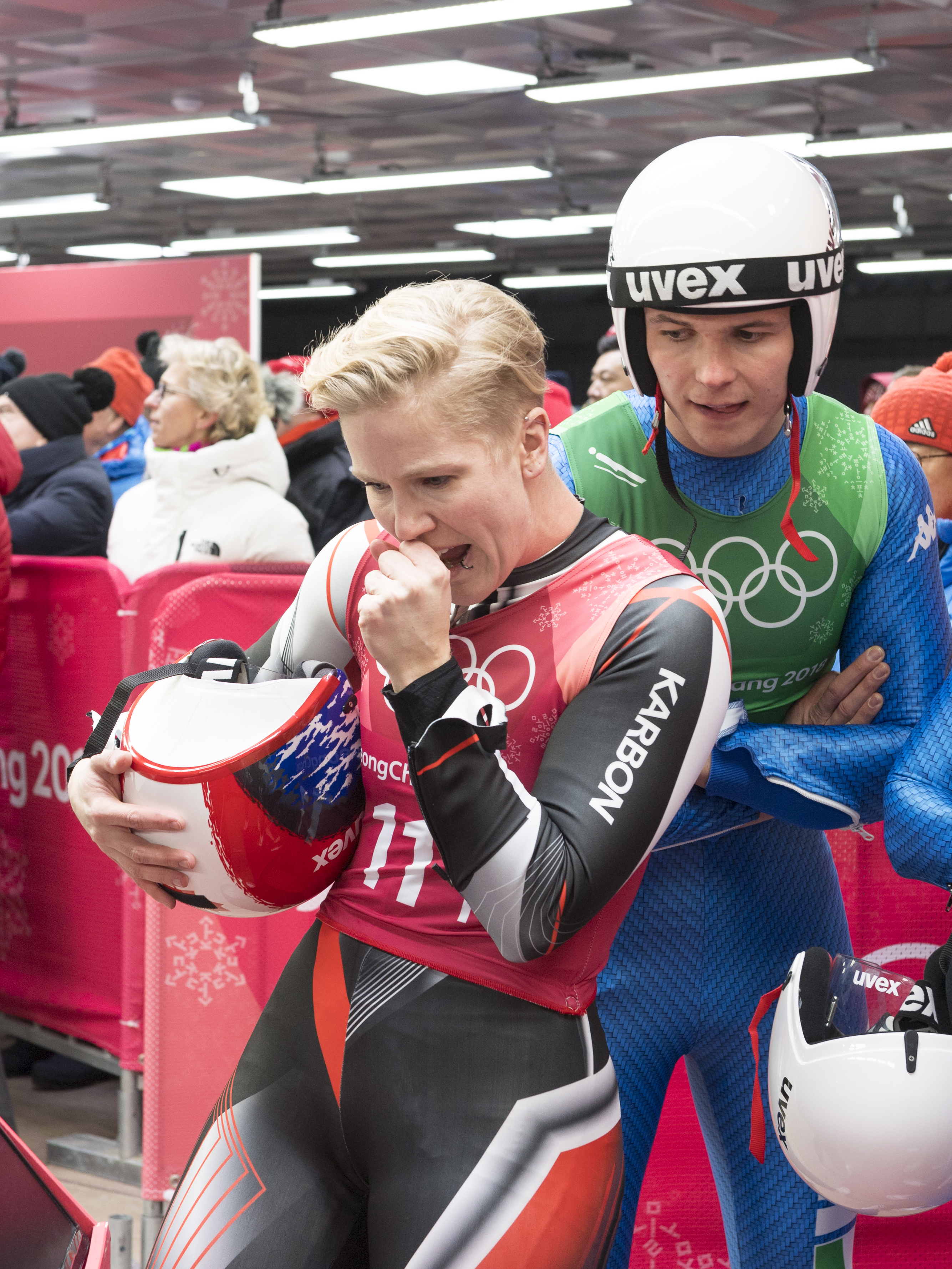
The Olympic cycle between Sochi 2014 and Pyeongchang 2018 was the final chapter of Gough’s career—and arguably the most challenging. Not physically, but mentally.
Instead of throwing herself fully back into the relentless grind of World Cup racing, Gough made an unconventional choice. With one eye on life beyond sport, she began studying civil engineering. For three years, she competed and trained only part-time, stepping away from the repetition and routine that usually define elite luge careers.
It was a risk. Luge rewards thousands of runs, consistency, and muscle memory. Stepping back—even temporarily—can cost athletes their edge. But for Gough, the reduced load became an advantage.
“I didn’t want to leave sport and start from scratch trying to figure out what was next,” she explained. “And I didn’t want sport to be the be-all and end-all of who I was.”
Her body, worn down by years on the sled, needed the break. So did her mind. When she returned fully in the final season before Pyeongchang, she did so with clarity.
“The goal wasn’t necessarily World Cups or overall rankings,” Gough said. “Those were build-up races. The Olympics were always the target.”
Strong results in Calgary and Lake Placid—both second places—showed she was back. Fourth overall in the World Cup standings confirmed that she was ready.
Mastering the mental game
What truly changed between Sochi and Pyeongchang, however, was Gough’s mental approach. She invested heavily in sports psychology, learning how to quiet the noise that had followed her through earlier Olympic experiences.
“I did a lot of work to let that noise go and focus fully on the run in front of me,” she said. “A good start, slide relaxed, good lines—that’s all you can do. It’s you against the clock.”
At the Alpensia Sliding Centre in Pyeongchang, those lessons paid off. Over four runs, Gough delivered calm, controlled performances. She remembers one small mistake—brushing the wall exiting Curve 9—that may have cost her a higher medal color. But she also remembers something else.
After her fourth run, she sat behind Germany’s Dajana Eitberger, with two German sliders still to come.
“Here we go—fourth again,” she thought.
Then the conditions shifted. Temperatures warmed. Times slowed. Tatjana Hüfner bled seconds—unexpectedly. When the race was over, Alex Gough stood third.

A medal that changed history
The bronze medal at the Pyeongchang 2018 Olympic Winter Games was historic: the first-ever Olympic luge medal for Canada. It was also the perfect closing chapter to Gough’s Olympic career.
“It doesn’t feel like that long ago,” she says now. “But when you put numbers to it, you realize how much time has passed.”
That medal was more than hardware. It was vindication—for the heartbreak of Sochi, for the years of quiet persistence, and for the belief that stepping away, studying, and preparing for life after sport had not weakened her focus, but strengthened it.
Life after the sled
Today, Gough is still based in Calgary, though her days look very different. Instead of training runs at Canada Olympic Park, she spends her time managing major water infrastructure projects as a project manager for a large general contractor. Pump stations, treatment plants, construction sites, financial reviews—each day brings new challenges.
“I really enjoy the overall work and the people I work with,” she says. “If you work with good people, it makes anything doable.”
She misses the sled. She misses the camaraderie and the race atmosphere. But she does not miss the physical toll of full-time training.
“I was lucky,” she reflects. “I wasn’t pushed out by injury or by someone better. I got to choose when it was time.”
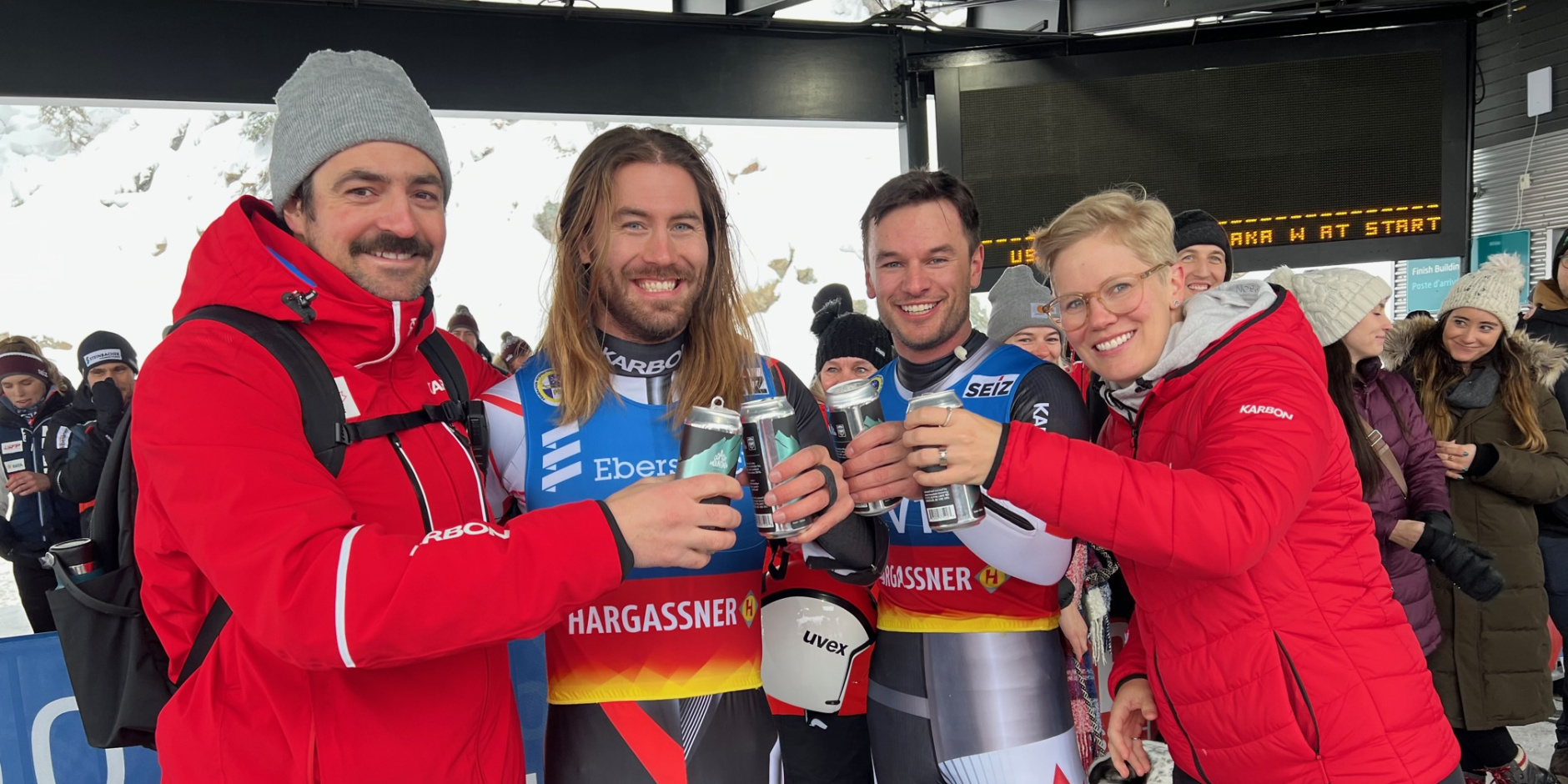
A legacy beyond medals
Olympic history often remembers only medal winners, but Alex Gough’s story is richer than a podium result alone. Her fourth place in Sochi made her bronze in Pyeongchang possible. Her willingness to step back from the sport helped her step forward as a more balanced athlete—and person.
For Canadian luge, her impact is lasting. She broke barriers, ended streaks, and proved that patience and perspective can be as powerful as raw speed. And for the next generation watching from the start ramp, her journey stands as a reminder: sometimes, the longest road leads to the most meaningful finish.