






Fewer Routes, Greater Impact
How FIL and DHL Are Rethinking Winter Sports
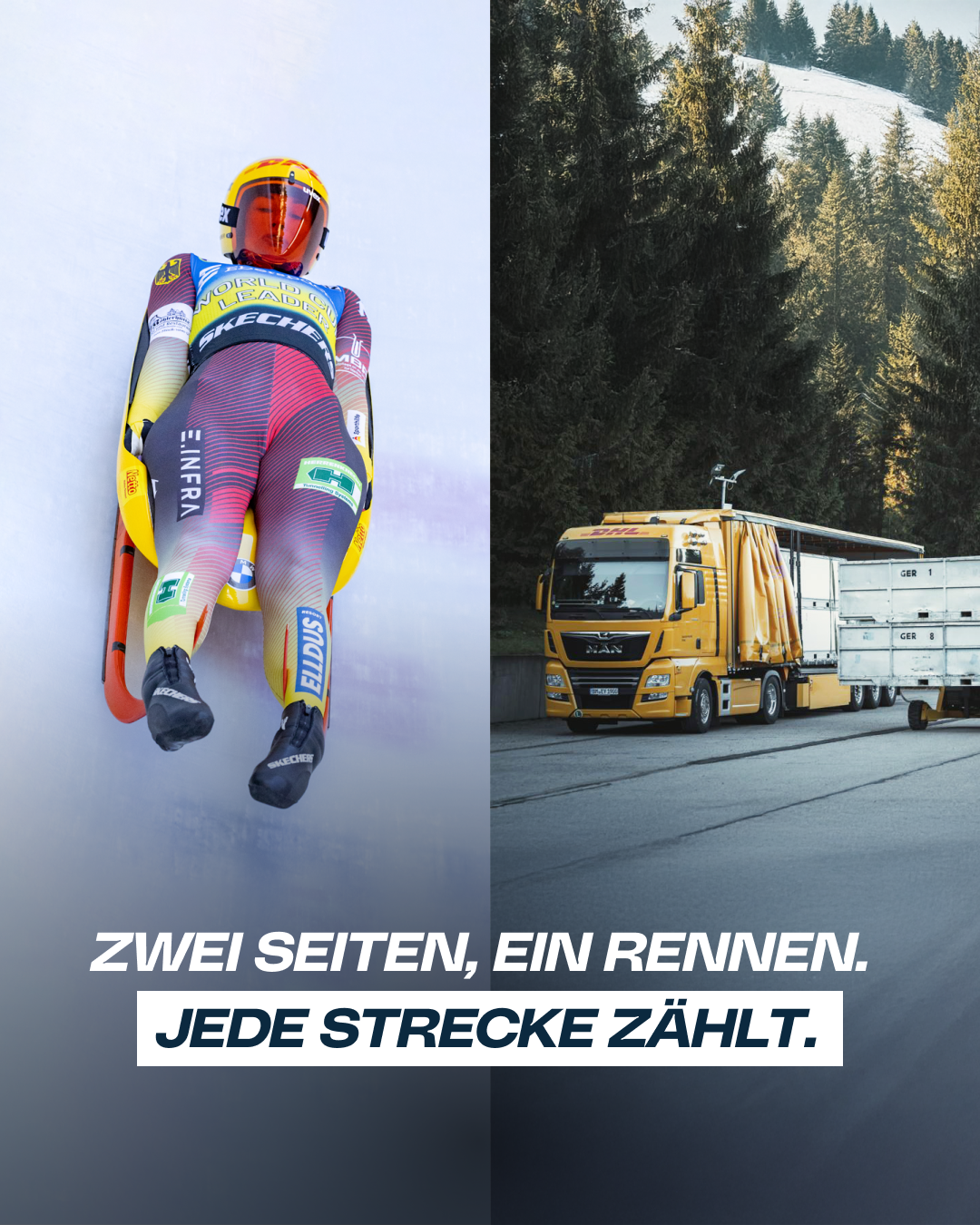
Berchtesgaden (FIL/14 Apr 2026) Winter sports thrive not only on their local and international stages but, above all, gain their appeal through their global presence. World Cups across three continents are what make the sport so appealing—but at the same time, they present the industry with a key challenge: How can international competitions be organized more sustainably?
The collaboration between the FIL (International Luge Federation) and DHL shows that this is precisely where the future begins—with smart logistics, data-driven planning, and a new understanding of efficiency.
With DHL Global Event Logistics, DHL has a team with specialized expertise in the sports, trade fair, and event sectors.
A new era in winter sports logistics
What used to be primarily about transportation is now a strategic lever.
The collaboration between the International Luge Federation (FIL) and DHL marks a decisive step toward a sustainable future for winter sports.
Since the 2023/24 season, DHL has been the federation’s official logistics partner, providing support for transportation, processes, and scheduling. This partnership directly embodies the values of speed, precision, and teamwork to ensure that “World Cup worldwide” does not automatically mean maximum travel expenses.
Logistics as the Key to Transformation
High-Tech Freight Under Extreme Conditions
Anyone who has ever seen how precisely sleds are packed and loaded quickly understands: this is high-tech freight. Luge equipment is among the most sensitive cargo in winter sports: precisely tuned sleds, runners, and technical gear. Transport must not only be fast but also exact. This precision also supports sustainability, as well-organized, damage-free transport avoids replacement shipments and additional, emission-intensive transport.
DHL describes winter sports event logistics as a mix of long-haul flights and precisely organized transport between European locations.
The sheer size of the transport containers illustrates the scale of the operation: we’re talking about dozens of large crates and pallets, with “over 20 crates” cited as the typical size for luge equipment alone. This logistics operation requires a high degree of flexibility. This is because spontaneous changes must be implemented immediately. For example, when equipment needs to be transported immediately just one hour after the award ceremony.
With DHL as its “Official Logistics Partner,” the FIL relies on a global network—and leverages the capabilities of modern logistics to make processes more efficient and environmentally conscious.
What’s changing specifically:
- Consolidated shipments instead of individual trips
- Central coordination of teams and equipment
- Digital, paperless processes
- Optimized route planning
An example: In 2026, equipment from North America was consolidated and transported to Europe, and from there efficiently redistributed—instead of using many parallel individual solutions.
Infobox: The Scale of Winter Sports Logistics
- Over 100 transport crates for luge equipment alone per event
- Transports often take place immediately after the competition ends (sometimes within an hour)
- Combination of long-haul flights and regional road transport
Conclusion: Sustainability in elite sports begins with transportation.
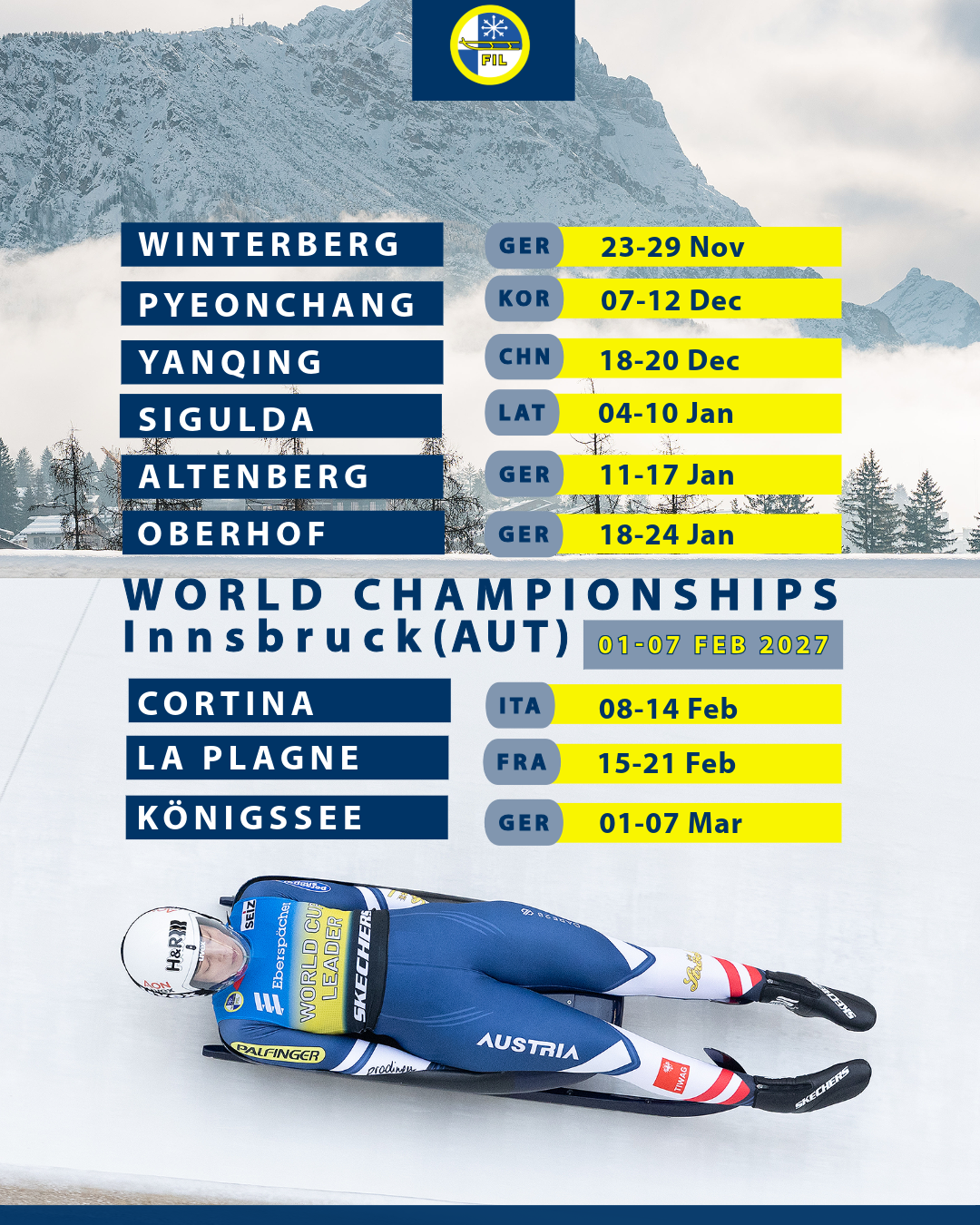
The race calendar becomes a climate factor
Even greater than the impact of individual transports, however, is the planning of the season itself. This is because the World Cup calendar determines how much travel actually takes place.
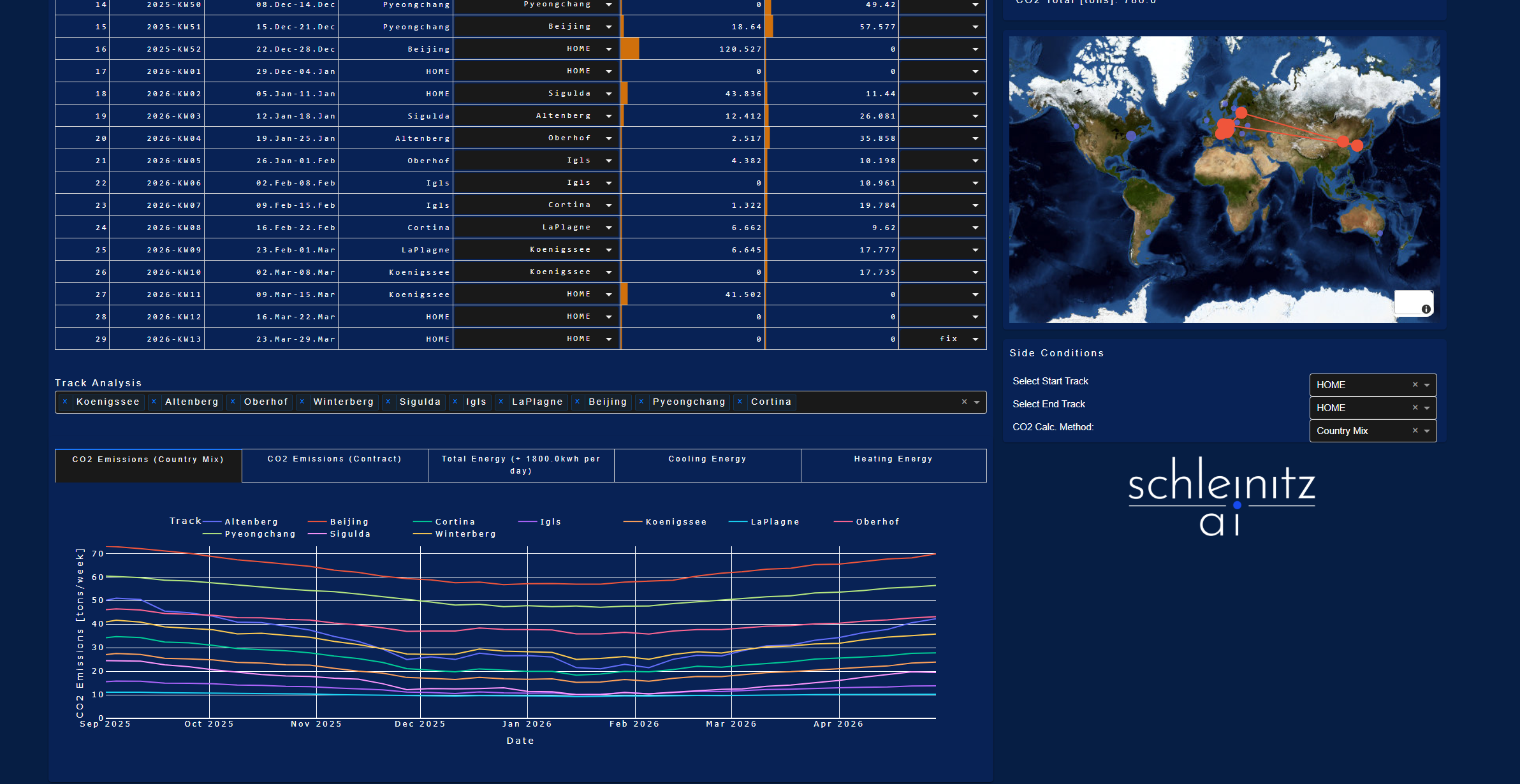
The FIL relies on a data-driven approach here. Routes are analyzed, emissions calculated, and various calendar options simulated. The goal: to cluster competitions geographically in such a way that unnecessary long-haul flights are avoided.
This system makes emissions transparent, allows scenarios to be compared, and enables decisions to be made based on this information.
Instead of switching between continents multiple times, clear regional blocks are created—for example, in Asia or North America—before returning to Europe. This is because the race calendar determines whether teams constantly switch continents—or can travel efficiently.
The FIL uses a data-driven approach for this:
- CO₂ analysis per route
- Simulation of various calendar options
- Planning by geographic clusters
The principle:
Clusters instead of continent-hopping
Example structure:
- Asia block (e.g., PyeongChang, Yanqing)
- North America block (Lake Placid → Park City → Whistler)
- Europe cluster with short distances
This creates a clear, measurable picture: Travel is the biggest lever—but only in combination with optimized logistics and smart event planning does the full effect unfold. According to FIL calculations, effective CO₂ savings can be achieved as a result:
Simply by optimizing the calendar, flight emissions can be reduced by up to per season in the travel sector.
Infographic (Text): Impact of Smart Planning
Possible only through calendar optimization:
- up to 30% fewer flight emissions
- approximately –120 tons of CO₂ per season (travel sector)
Info Box: Impact of Smart Planning
- Up to –30% flight emissions
- Approximately –120 tons of CO₂ per season (Travel)
The biggest lever lies in the calendar, not in individual transportation.
Efficiency through consolidation and pilot projects
In winter sports, sustainability means, in concrete terms, more efficient and sustainable travel routes for teams and equipment. A pilot project for European logistics was already carried out during the 2025–2026 season, involving centralized sled and equipment transport from the World Cups in the U.S. (Park City and Lake Placid) to Latvia (Sigulda) and on to the next World Cup in Germany (Winterberg).
In the future, European transport services will also be centrally offered by DHL to increase travel efficiency. By consolidating overseas group shipments with DHL, more efficient routes are created, which significantly reduces the CO2e footprint of international competition.
Traveling together instead of separately
New solutions are also emerging for local transport. The FIL is testing shared mobility concepts, particularly for overseas World Cups.
In Asia, for example, centralized shuttle systems have been introduced, allowing teams to travel together instead of using their own vehicles. This model was successfully tested as early as 2025 and demonstrates how collaboration creates efficiency.
Traveling together: new transportation models
New approaches outside Europe are particularly innovative.
In Asia, the FIL is focusing on:
- centralized shuttle systems
- shared team transportation
- elimination of individual vehicles
Instead of many individual team buses, a coordinated overall system is created.
Such a model was already successfully tested in 2025.
The combined effect
The real strength lies in the synergy of all measures:
- smart logistics (DHL)
- an optimized race calendar
- climate-conscious event planning
Results according to scenarios:
20–25% less CO₂ per season
And without:
- fewer competitions
- restrictions for athletes
- loss of international presence
What this means for winter sports
The cooperation between FIL and DHL signals a paradigm shift:
- Logistics becomes a strategic tool
- Data enables strategic planning
- Sustainability arises from the system, not from individual measures
Or, in other words:
Winter sports remain global—but are organized more intelligently.
The future of the FIL World Cups
The collaboration demonstrates that a global presence in sports does not automatically mean “maximum travel costs” when planning, consolidation, and data-driven decisions work together.
Fewer trips lead to fewer emissions—that is the core message of the new logistics strategy. This operational excellence ensures that athletes and equipment arrive on time and in good condition from venue to venue, regardless of whether they are competing in Europe, Asia, or North America. The FIL is thus leveraging the technological advantage of a global logistics network to uphold the integrity of competitions while simultaneously taking responsibility for the environment.
As a potential next step, the FIL is exploring the use of sustainable fuels for air and road transport—solutions that could further reduce CO₂e emissions. With DHL as a partner offering precisely these options, the path to a more sustainable logistics future is already taking shape. Ultimately, this development helps ensure that winter sports can continue to shine on the international stage—while remaining true to our responsibility toward our planet.