





La Plagne Is Here to Stay. And It Is Getting Better.
It was February, thirty-four years ago. The Albertville Winter Olympics brought luge to the French Alps – on a track built specifically for the occasion, nestled deep in the mountain landscape above Aime-la-Plagne. More than three decades later, the Olympic Winter Games are returning to this region. And the track that delivered world-class luge racing in 1992 is set to take centre stage once again in 2030. This is what sustainability looks like. This is what legacy means.
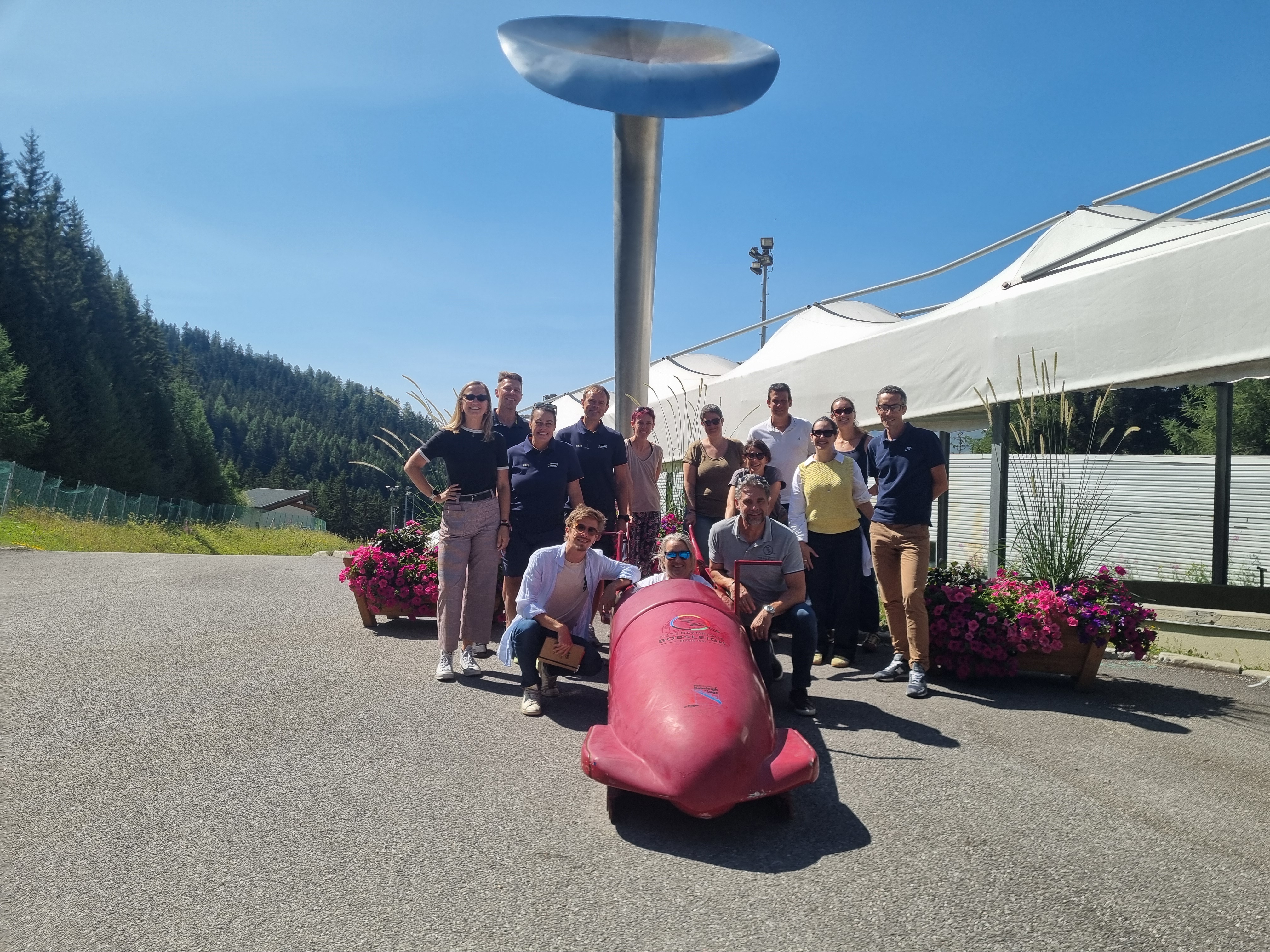
On 22 and 23 July 2026, the sliding federations conducted their first official visit to the Piste Olympique de Bobsleigh in La Plagne. FIL Sports Director Matthias Böhmer represented the FIL on site, together with representatives of the IBSF, the Alpes françaises 2030 organising committee, construction body Solideo and venue operator SIGP. It was a working visit in every sense: two days of site inspections, presentations and discussions about the future of a venue that has already made history.
Matthias Böhmer summed it up: "It is a pleasure to return to a track that already carries Olympic memories. The visit went very well overall, because we all share the same values and are working towards the same great goal."
Renovate, Don't Rebuild
The centrepiece of the discussions was the planned renovation work ahead of the 2030 Games. The message is clear – and from a sustainability perspective, entirely welcome: the vast majority of the venue will be renovated, not rebuilt. Only a very limited number of new structures are planned. In concrete terms, this means all buildings will be refurbished, the shading systems updated, the internal technological infrastructure modernised and the track lighting brought up to the latest standards.
This is more than a technical decision. It is a clear commitment to the principle that the FIL's strategy "We Slide Forward 2034" and the IOC's agenda for the coming Winter Games share equally: use existing infrastructure, protect it and prepare it for the future, rather than starting from scratch every time. La Plagne 1992 – La Plagne 2030: one track, two Olympic Winter Games, one philosophy.
For the FIL, this first visit marked an important step in the long process of preparation for the 2030 Games. The next stages will follow – with clear milestones and a roadmap that was jointly outlined during the closing wrap-up session on 23 July.
And Who Won the Gold Medals Back Then?
In men's singles, Georg Hackl (Germany) triumphed ahead of Markus Prock (Austria). In women's singles, Doris Neuner (Austria) claimed gold – with her sister Angelika in second place, a rare sibling podium in Olympic history. In doubles, Stefan Krauße and Jan Behrendt (Germany) won by the narrowest of margins over their compatriots Yves Mankel and Thomas Rudolph. And in third place in the doubles, incidentally: Hansjörg Raffl and Norbert Huber of Italy – the very pair who would go on to win the overall World Cup eight times, setting a record that remains unbroken to this day.
La Plagne knows how to produce champions. New stories will not wait until 2030 – the FIL World Cup 2026/27 is already scheduled in the French Alps from 15 to 21 February.