






The Man Who Builds Things That Last
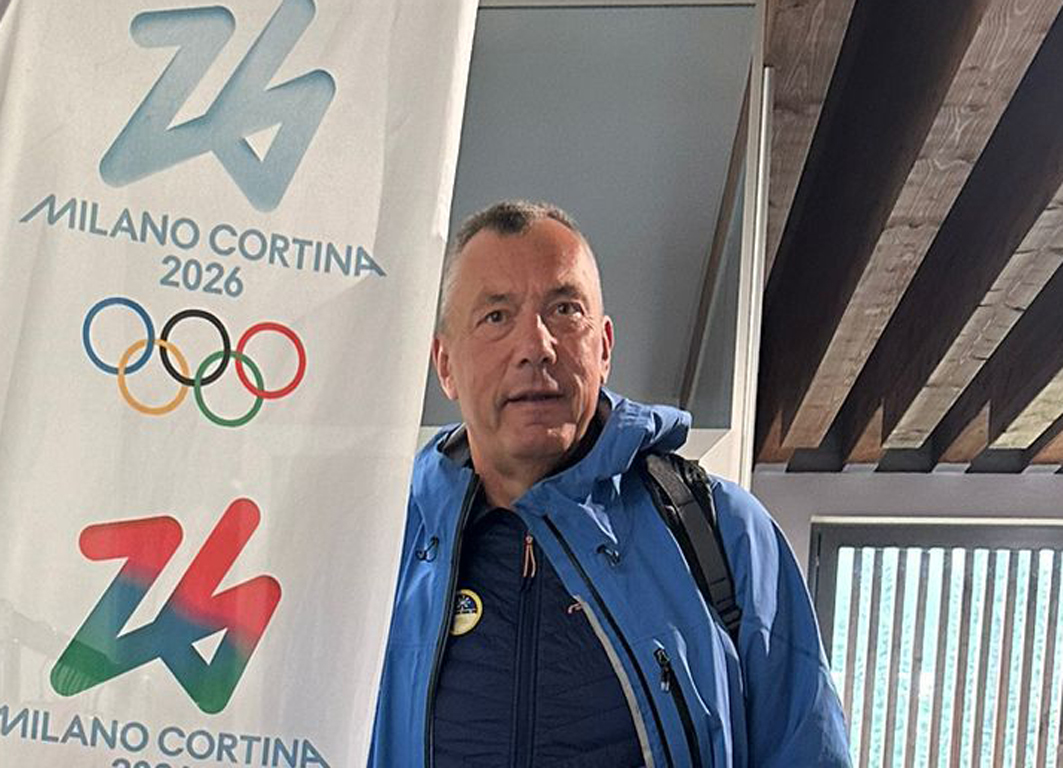
There is a thread that runs through the life of Einars Fogelis, and it has nothing to do with titles or mandates. It has to do with building. As a young engineer in Sigulda, Latvia, he built and ran the sliding track that would become one of the fastest and most demanding venues in the world. As FIL President since 2020, he has built a strategic framework, a sustainability programme, a four-year calendar and a pioneering AI assistant. And as a member of the IOC Future Host Commission for the Olympic Winter Games – the body that evaluates and recommends where the Games go – he helps decide which venues will carry the sport into the decades ahead.
It is an unusual combination of roles. But for those who know Fogelis, it makes complete sense.
A sport on the right track
Milano-Cortina 2026 was, by any measure, a success for luge. Five gold medal moments, a record-breaking men's performance from Max Langenhan, Julia Taubitz's gold after her Beijing heartbreak, and the historic premiere of Women's Doubles. The Cortina sliding track – built in eleven months, questioned by many, doubted by some – delivered on every level. "What was achieved in Cortina in eleven months was incredible," Fogelis says. "The feedback from athletes, from race directors, from local organisers was unambiguous."
But what he points to with equal pride is what happens next. The Cortina track will not be locked up and forgotten. From October 2026, training is confirmed and communicated to national federations. A brand-new Olympic sliding venue, now integrated into the sport's future calendar. "The track as an asset, not a memory," as Fogelis puts it – and a direct expression of the FIL's sustainability philosophy.
The horizon that others envy
Fogelis sits on the IOC Future Host Commission for the Olympic Winter Games – the body, chaired by IOC Member Karl Stoss, that evaluates and recommends candidate cities and regions for future Winter Games. It is a role that places him at the intersection of sport, infrastructure and global strategy, and one that gives him a perspective on luge's position that few federation presidents can match.
"It is always an honour to serve on an IOC Commission," he says. "But the one dealing with Future Hosts carries a particular responsibility in the years ahead. We live in geopolitically and climatically challenging times – and yet we all want not only the Olympic idea to survive, but also to ensure that beyond 2034 we have attractive venues for the Olympic Winter Games."
From that vantage point, the picture for luge is clear. La Plagne hosts the sliding events in 2030 – a track built for the Albertville Olympics in 1992 that needs no introduction. Salt Lake City in 2034 returns the Games to a venue that already knows how to stage world-class sliding sport. And 2038, should the dialogue between the IOC and Switzerland lead to a hosting award, the sliding infrastructure question is answered before the host decision is even final. "For the next two, three Games, the situation regarding tracks looks very good," Fogelis notes.
It is a statement that carries particular weight coming from someone who spends part of his institutional life assessing exactly those kinds of questions. The FIL's answer to the Olympic movement's demands for relevance, efficiency and universality – a growing discipline portfolio, a global track network, a four-year calendar – is, in his view, a strong one. But he is not complacent. "Nobody guarantees a permanent place in the Olympic sports calendar," he acknowledges. "That place must be earned – continuously, collectively, with every national federation pulling in the same direction."
Thirty-two years of perspective
Fogelis joined the FIL Executive Board in 1994, the year founding president Bert Isatitsch passed away and Josef Fendt stepped in to begin a 26-year presidency. He is only the third president in the federation's history. Before taking office in 2020, he spent eleven years as track chief, chief engineer and director of the Sigulda sliding venue. His background is not that of a career administrator. It is that of a man who knows what it takes to build something that lasts.
That instinct runs through everything he does. The four-year calendar. “We Slide Forward 2034”. The sustainability framework. LAIA, the FIL's AI assistant – the first of its kind in Olympic winter sport. The Asia visits of June 2026, where four-year cooperation frameworks were agreed with China and Korea just days after the Berchtesgaden Congress. None of it is isolated. It is the architecture of a federation that intends to be relevant not just today but in 2034 and beyond.
"Cortina went well because the whole FIL played along," Fogelis says. "It was everyone's result." It is perhaps the most telling thing he says. Not the president's result. Not the host's result. Everyone's. For a man who has spent his life building things designed to outlast him, that is exactly the point.
Einars Fogelis has served as FIL President since November 2020. He was re-elected by acclamation at the 74th FIL Congress in Berchtesgaden in June 2026 and is only the third president in the federation's history, following Bert Isatitsch of Austria and Josef Fendt of Germany. He is a member of the IOC Future Host Commission for the Olympic Winter Games.