





Alone at the start, never alone on the journey
Five nations are represented by just one athlete each at the EBERSPÄCHER World Cup opener in Winterberg. Behind each of them stands a network of partners, teams and supporters: the luge family.
On Sunday, Natalie Maag turns 29. She will celebrate at the VELTINS-EisArena Winterberg, at the first women's single race of the 50th World Cup season. "I'm used to having my birthday at luge races," says the Swiss athlete. "Hopefully it's a good omen." Her family is travelling to the race.
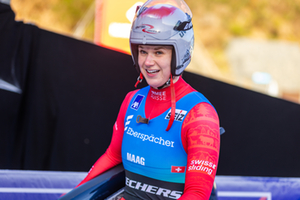
Maag is the only female luger from her country at World Cup level, yet she does not feel alone. "I don't even notice that I'm travelling alone. Except maybe at the opening ceremony of a World Championships, when I march in alone with the Swiss flag," she says. "I've been part of the German team since my junior days, all these years, forever. I don't know it any other way."
For her, competition and solidarity are not a contradiction. "Of course there's rivalry, we're all athletes. But that happens on the track," says Maag. "We are competitors, but we are also happy for the others." Her eyes are firmly set on the future: "It's an interim season on the way to La Plagne 2030."
Four other athletes in Winterberg share Maag's situation. Switzerland, Norway, Japan, Estonia, and Bosnia and Herzegovina each have only one sled at the start, while in total the 114 athletes come from 15 nations. But a closer look reveals that none of them is travelling alone.
A programme that builds bridges
Part of this support is built into the system at the Fédération Internationale de Luge: in the FIL Partnership Programme, strong luge nations support athletes from smaller countries. Germany looks after athletes from Switzerland, Poland and Argentina, the USA supports Japan, Australia and Slovakia, and Austria takes care of Norway and Sweden. Then there is Latvia, which supports Estonia and Finland, and Italy, which looks after Bosnia and Herzegovina. Sports Director Matthias Böhmer sums it up: "Luge is a global reality, and through support programmes we strengthen the base. That is a defining trait of our sport – that everyone is there for everyone else and that we continue to grow together."
Seiya Kobayashi, Japan
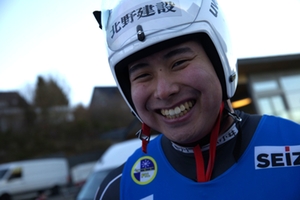
Not everyone finds being alone so easy. "I am indeed a little sad that I travel alone on the World Cup," says Seiya Kobayashi. "I feel that I miss having teammates and conversations in Japanese." At the World Cups in PyeongChang and Yanqing, too, the 25-year-old will be the only Japanese athlete. But something is growing: "We have three good youth athletes. Luge in Japan is developing."
He finds stability in the FIL Partnership Programme, in which he is under the wing of USA Luge. "By nature I'm rather sceptical and anxious, and that's why it does me so much good to be anchored in the US team," says Kobayashi. "I've been able to work with USA Luge for four years now, since Beijing 2022, and every summer I train with them in Lake Placid. They're great guys, positive and optimistic by nature, and that rubs off on everyone around them."
Kobayashi learned to luge in his home town of Iizuna near Nagano, on the "Spiral", the track of the 1998 Olympic Winter Games. It has not been iced since 2018. "It's such a fascinating track, and I regret that it isn't being used at the moment," he says.
Ola Brandstadmoen, Norway
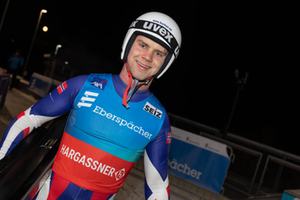
At 19, Ola Brandstadmoen is the youngest of the five, and he puts his thoughts into words reflectively. "It feels a bit lonely, and it would be great to have more Norwegians here. It's difficult to manage everything on my own, it's not that easy," he says. "But there are nice people around me. I would say we are a Scandinavian team, Sweden and Norway. And I'm supported by the Austrians, which makes it easier to move forward and up faster."
At the 2024 Winter Youth Olympic Games in Gangwon, Brandstadmoen carried Norway's flag and finished sixth. His breakthrough came last February on his home track: "In Lillehammer I won the Junior World Cup race and finished second at the Junior European Championships. After that I knew that I can slide well and that I can achieve good results with the right training."
In the FIL Partnership Programme, Austria stands by his side, and this has grown into a close working relationship. "The support from the Austrians started with me getting feedback from them after my runs, and that has kept increasing. In the last two years I've received sleds from them, and I try to do as much as possible with them, for example staying in the same hotel," says Brandstadmoen. "My plan is to continue this cooperation, because La Plagne is my big goal."
Emma Triin Seer, Estonia
"It's amazing to represent Estonia after 20 years of absence," says Emma Triin Seer. "And it's great to be here, even alone. I try to look at the positive side and not to think that it would be nice to have teammates here with me."
The 22-year-old came to luge from athletics, where she competed in the heptathlon and sprint. "When I had to choose between luge and skeleton, I chose luge because, from my point of view, it's more difficult." In just two years she made it to the World Cup. She is coached by her father, Marek Seer, head coach of the Estonian national team, who narrowly missed the 1998 Olympic Games in Nagano. His daughter also narrowly missed qualifying for Cortina.
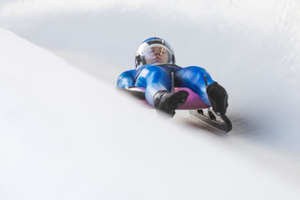
On the road to the next Games, a neighbouring country is helping her: there is a cooperation with the Latvian federation. "The cooperation with Latvia runs for four years, until La Plagne. Depending on when I have time, I can train with the national team or with the junior team," says Seer. "It's so important to get feedback from their coaches after a run. And of course I really appreciate their work on the sleds." Sigulda has long since become her home track. "I'm looking forward to the World Cup there. Sigulda is easier to race than Winterberg, where you have to go with the flow."
Mirza Nikolajev, Bosnia and Herzegovina
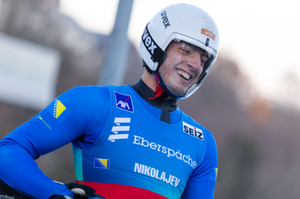
None of the five has known being alone on the World Cup as long as Mirza Nikolajev. "Because I've been travelling alone for so many years, it has almost become normal," says the 25-year-old from Sarajevo. "Before, I had three teammates, and that made things easier in terms of training and organisation during the season. Somehow it's a medal with two sides: on the one hand, you don't have to follow anyone and you're free to do what you want. On the other hand, you miss teammates who are close to you."
In 2022, Nikolajev carried his country's flag in Beijing, the first Bosnian Olympic luger in 24 years. His story is told in the documentary "The Track". "The film, the way it turned out, came about by chance," says Nikolajev. "The idea for a luge film came from a training session in Sarajevo, where I still train. But then it became a film about luge and life: what it's like to do this sport without funding, and what it's like to practise sport in a post-war country."
Since this season, he too has a strong partner at his side. "The partnership programme with Italy started this season. Italy supports me with coaching expertise, with information after my runs and with sled know-how. I travel with them, and this cooperation should continue for longer," says Nikolajev. "My goal is La Plagne, and 2029/30 will be my last season, I already know that today."
A family in the ice channel
In the conversations, the same place comes up again and again: La Plagne. Natalie Maag, Ola Brandstadmoen, Emma Triin Seer and Mirza Nikolajev name the 2030 Olympic track as their big goal, and all four know that they will not travel that road alone. For Seiya Kobayashi, the idea of the luge family reaches even further, all the way home. "That is what I wish would come back in the future," he says of the Spiral in Nagano, "that there will be races there again, and that the whole luge family will be our guests."
In the coming days – no: throughout this season – Natalie Maag, Seiya Kobayashi, Ola Brandstadmoen, Emma Triin Seer and Mirza Nikolajev will be racing for their countries. And, in a way, for a family that is bigger than any nation.


